

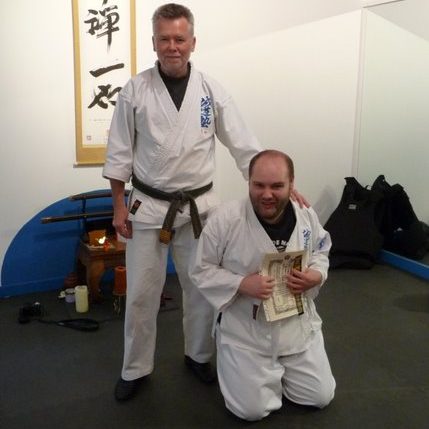
Richard Parker began his Seido Karate journey back in 2008, at the age of 27.
Roger Thyer-Jones, 6th Dan from the World Seido Karate Organisation in the UK had experience of teaching visually impaired students and so began a partnership that was to take Richard all the way to Black Belt Nidan. Richard, Roger, and Drina and Michael (Richard’s parents) told us about Richard’s journey to Nidan:
Roger: I was hard on Richard. I expected the best that he could achieve in the sessions and made no excuses for him. We had to build a firm foundation if he was to progress. However, I knew that whatever I required him to do, he had suffered worse throughout his life. He had had to deal with school bullies, manage his own self-worth as he grew older knowing that he could never fully engage in his family’s world except on his own terms. I knew that he was tough-minded and even with the support of his family, he had had to be locked in his own mind coping the best way he could. The karate training that he was experiencing was nothing compared to dealing with endless hospital visits and the slow progression of sight loss at a young age. Richard already had taken the path of the Way of the Warrior, he just didn’t know it. I was simply a guide on the new path that he had chosen.”
One of my favourite films is based on an old Japanese movie series depicting the life of Zatoichi-Ichi the blind monk. Ichi san carried a sword hidden in his walking stick and roamed feudal Japan righting wrongs and defending the weak from bullies. The Japanese loved his character and did not view his lack of sight as a hindrance to what he was capable of. He was a martial artist. The idea of him being able not only to defend himself, but to defend others who were sighted, gave the series an unexpected twist. Difference definitely did not mean deficit.
I had great respect for Richard’s loss of sight but at no time during our relationship did I ever pity him. I treated him like any other student and it was my responsibility to find the key that unlocked his abilities. It was his responsibility to keep an open mind and practice the drills that I gave him so that we could build a firm foundation for advancement. A true partnership.
Has it been tough for Richard? Yes. Besides laughter we had tears of frustration, melt downs when he just couldn’t reproduce a technique to the standard required, but not once in our relationship did I patronise him. My favourite saying is: even monkeys fall out of trees. Expect to make mistakes but learn from them.
Drina: When Richard achieved his Black Belt Shodan, First Dan, we were very proud but did not for a moment imagine that he could go beyond this amazing achievement. However, at the end of last year that is exactly what he did when he went through the rigorous grading to be awarded his Black Belt Nidan (Second Dan).
Nidan is a difficult enough preparation process for the able-bodied candidates to go through, those without Richard’s challenges. The year of building up to his grading was particularly tough for Richard. He had written an essay as part of his preparation for his Shodan when he had written about his life’s experiences which he didn’t find too daunting. For Nidan, he had to write on the subject of ‘Balance’ with particular reference to how Seido Karate impacted on balancing his life. Richard struggled with the concept until a light bulb moment when he realised that balance can be applied to every aspect of life – even his beloved football team!”
The physical training and the early morning sessions with other Black Belts were tough. Dojos were just opening up after the lockdown during Covid so it was a novel experience to be back training with real live people rather than on Zoom. It was more exacting too. His teacher and mentor, Sei Shihan Roger Thyer-Jones, gave Richard confidence in his ability and patiently guided him throughout the year.
Richard: The first part of my Seido Karate Nidan Black Belt promotion was to do a series of kata. These are set patterns of movements, variations of which are used in all martial arts. The order and exact form of movement have to be memorised. Since I am blind, unlike others in my dojo, I have to try to picture the shapes and can’t copy from my teacher or other trainees. I was instructed to perform many kata, chosen by the examiners and then I could choose my favourite kata: I chose to do the breathing one, called Sanshin, which translates into three battles signifying the unification of the mind, body and spirit.”
I then had to talk, uninterrupted, for four minutes about my essay which was on the subject of balance and afterwards answer questions about it from all members of the dojo. I found it very difficult to write the essay and even more difficult to talk about it, but I had practised with my parents and, in the end, I went with the flow and just thought of it as if I was talking normally down the pub or at football. It went very well and I wasn’t given questions that were too difficult, so I was able to answer them without getting too nervous.
The second formal part of the grading was a series of different fighting moves using weapons called a bo and a jo. These were new to me until I started training for my Nidan promotion. Learning to use these weapons was very difficult to start with, but I had lots of practice and eventually got the hang of It.
The final part of the grading was a long series of karate fighting bouts called kumite, during which I wore protective fighting gear and boxing gloves. This seemed to go on for hours but it was great fun to let off steam and go for it. I felt very proud when Sei Shihan Roger presented me with my Nidan Black Belt after which we all went to the nearby pub to celebrate.
Drina: From a parent’s perspective it was emotional during kumite, the fighting parts of the challenge, to see Richard stretching every sinew with fully-focused concentration. He had to locate his opponent (with the help of a tambourine being activated by another member of the dojo) and strike with his bo or jo, the long sticks used as weapons and introduced at this stage. His concentration and memory were further called upon when performing a series of defensive Kata involving complex moves and patterns.
To add to the mix of stress, Richard had Covid between his first and second grading sessions but he refused to be daunted by this and remained determined to succeed.
Both Michael and I were willing every fighting bout to be the last one but even though Richard was physically exhausted and pouring sweat at the end of the fighting component of his grading, he did not falter in his ambition to succeed. Throughout both grading sessions, the other members of the dojo shouted encouragement which lifted Richard’s spirit and helped him to keep going.
His forays with his bo gave rise to some anxiety in his opponents who were fortunately well-protected by padded head gear! One of the most advanced Black Belts complimented Richard’s perfect hand positions and finely tuned grip adjustments. He also commented that Richard’s punches were among the most powerful in the dojo!”
Roger: Richard has now achieved what he once thought was impossible. His first degree black belt, Shodan, which he gained pre-Covid lockdown, involved not only demanding technical ability but true grit in having to complete 40 fights against able-bodied opponents. His second degree black belt, Nidan, which he achieved in November 2022, involved the complex use of weapons as well as demanding self-defences, techniques that involved 360 degree turns and patterns of over 100 techniques to remember and reproduce. He was confident enough to stand in front of a class of his peers and instructors and lead the exercises giving clear commands. In his essay, which is part of the black belt process, he wrote clearly on the difficult subject of balance, which he applied to every aspect of his life.
He is not now the same Richard that set out so many years ago, stamping his feet on my studio floor, out of balance and out of breath. We are proud that he is an important part of the UK World Seido Karate Organisation.
He is an inspiration to students of every ability. Our blind warrior.